And uncertainty is the one ingredient Muslim travelers won’t swallow.
In my last piece, I argued that Halal logos alone won’t save your brand, because Muslim consumers don’t build loyalty on labels; they build it on trust.
This article is the follow-up I’ve been wanting to write for a while: the uncomfortable truth about Halal assurance in restaurants, especially non-Muslim owned and managed ones.
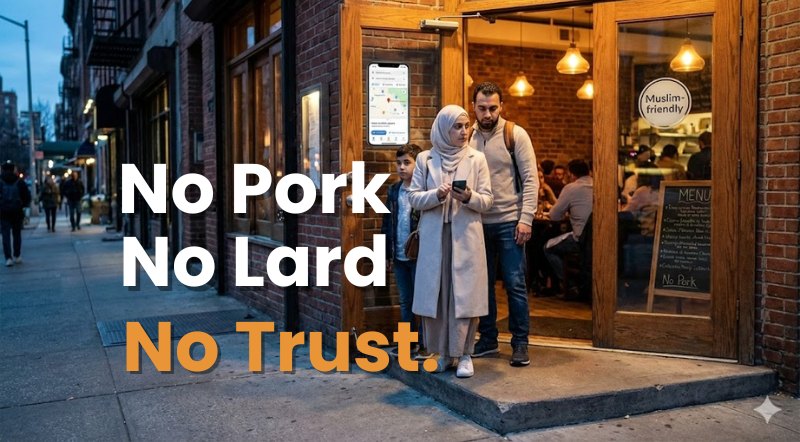
Muslim travelers don’t walk into a restaurant thinking, “Let’s make this complicated.” They walk in hoping for something simple: a meal they can trust. But when the only signal is a vague claim, “No Pork No Lard,” or the newer favorite, “Muslim-friendly restaurant,” they’re forced into risk management. And most will quietly walk out.
Because for Muslims, Halal isn’t a lifestyle preference; it’s part of daily spiritual discipline. Getting it wrong doesn’t just spoil dinner; it can create real anxiety and a sense of spiritual compromise that lingers through the trip. That’s why the Halal logo matters, not as a graphic, but as a mark of verified assurance.
So let’s zoom in on the real issue behind Halal dining today: not food quality, but confidence.
This piece is a straight talk for restaurants: why self-declared Halal doesn’t work anymore, what modern Muslim diners are actually evaluating (hint: it’s not your good intentions), and the practical steps to move from “maybe” to “trusted.”
Picture this.
A Muslim family is on holiday. The kids are hungry. The parents are tired. They walk into your restaurant, great atmosphere, great reviews, great plating. Then they look around and see… no clear Halal certification. Maybe a “No Pork No Lard” sign. Perhaps a staff member says, “Yes, yes, it’s Halal.”
That family pauses.
Not because they’re dramatic. Because the decision isn’t just about taste.
They exchange that subtle look, the one that says “Do we want to risk it?”, and they walk out. They don’t leave a one-star review. They don’t complain. They simply disappear from your revenue line.
And here’s the part the industry keeps underestimating:
For Muslims, Halal is not a lifestyle trend. It’s not “clean eating.” It’s not a preference like gluten-free.
So yes, Muslim diners ask more questions. They avoid unclear answers. They look for verification.
They’re not being difficult.
They’re protecting their spiritual well-being… while trying to enjoy the same simple thing every traveler wants: a meal they can trust.
Many non-Muslim owned and managed restaurants still lean on self-regulated claims: vague promises, signage, verbal assurances. Nothing more than, “just trust me.”
That might have worked when information was scarce and options were limited.
But we’re now in a world of:
Instant information
AI search
Map filters
Short video reviews
Traveler communities that share “safe lists” in seconds
For the next phase of Muslim travel, trust is not a feeling. It’s a system.
And now there’s a new trend emerging: the “Muslim-friendly restaurant.”
On paper, it sounds inclusive. In practice, it often means nothing specific.
It says “We’re friendly… but don’t ask for details.”
Some restaurants use “Muslim-friendly” to avoid the accountability that comes with the word Halal. It becomes a convenient umbrella term that can cover anything from “we don’t serve pork” to “we have Halal chicken sometimes” to “we’re happy to remove bacon if you ask.”
That’s not Muslim-friendly. That’s ambiguity-friendly.
So let’s be clear: self-declared Halal is no longer “better than nothing.” It actively erodes confidence and pushes away the very customers you think you’re attracting.
Independent verification isn’t an extra.
It’s the entry ticket.
This isn’t about being “sensitive.” It’s not about anyone being “too strict.”
It’s about observable consumer behavior.
In our tracking of traveler dining preferences, one pattern shows up consistently:
Halal-certified restaurants are the clear leaders in trust.
Non-Muslim owned/managed restaurants that “assure” everything is Halal, without certification, sit in a grey zone.
And when alcohol is part of the environment, trust drops even further.
Even if your restaurant is clean, friendly, and genuinely trying, many Muslim travelers still won’t take the leap if they can’t verify your claim. Once alcohol enters the picture, the doubt isn’t subtle; it becomes more difficult.
At that point, the traveler isn’t judging your food. They’re doing risk management.
And the quiet decision is simple: “I’m not gambling my trip on your assurance.”
The real problem isn’t that Muslim travelers reject your food.
They reject uncertainty.
And online, uncertainty doesn’t get “another chance.” People don’t debate. They don’t argue. They just choose somewhere else.
Some restaurants post “No Pork No Lard” signs with good intent.
But for many Muslim diners, it does the opposite of what you hope.
Because they’ve learned what it often really means:
“We don’t fully understand Halal, but we’d like your money anyway.”
In Singapore, our survey findings show many consumers avoid such places and view these signs negatively, often perceiving them as marketing-first rather than faith-aligned (Mastercard-CrescentRating Halal Food Lifestyle Singapore, 2021)
Again, this isn’t about shaming anyone. It’s about what the sign fails to address:
It doesn’t confirm sourcing.
It doesn’t confirm slaughter requirements.
It doesn’t confirm segregation and cross-contamination controls.
It doesn’t address alcohol.
It doesn’t create accountability.
Therefore, it doesn’t signal assurance.
It signals partial understanding.
And the next generation of Muslim travelers will not reward partial understanding. They will reward verified clarity.
Let’s be honest: Muslim-friendly has become a way to sound respectful without committing to any operational changes.
If “Muslim-friendly” is not backed by clear, verifiable standards, it forces the traveler to do extra work:
“Is the meat Halal-certified?”
“Is alcohol served?”
“Do you use separate utensils and prep areas?”
“Is there cross-contamination risk?”
“Who is verifying this?”
And once the traveler has to interrogate your menu like an auditor… you’ve already lost the moment.
Because travelers aren’t looking for a negotiation, they’re looking for confidence.
So here’s the uncomfortable truth:
A restaurant that markets itself as “Muslim-friendly” but cannot clearly state its Halal assurance is not being inclusive. It’s being evasive.
One of the most expensive misunderstandings in this space is the idea that Halal is just “no pork.”
That’s not Halal. That’s a partial ingredient preference.
Halal is a system that includes ingredients, handling, supply chain, cleanliness protocols, and environment. Without independent verification, a restaurant usually can’t credibly guarantee non-negotiables such as:
Muslim diners often need certainty that meat is sourced ethically and slaughtered according to Islamic principles.
“We buy from a supplier who said it’s okay” is not assurance. It’s hearsay.
Even with Halal ingredients, contamination can happen through logistics, shared fryers, utensils, surfaces, storage, and prep flow. Certification bodies audit these controls. Self-claims do not prove them.
Many establishments underestimate how much alcohol changes perception. Alcohol used in cooking, served on premises, or handled in shared areas can undermine trust, regardless of whether the food itself is “Halal.”
So when you claim Halal without third-party assurance, the traveler is forced to ask:
“Is your Halal my Halal… or your own version?”
If the traveler asks too many questions, the decision is already made.
Restaurants often avoid certification with familiar lines:
“Certification takes time.”
“It costs money.”
“We’re small.”
But let’s not pretend this is a neutral choice.
In reality, avoiding verification often means:
you get filtered out online,
you lose group bookings,
you miss repeat visits,
you never make it onto the “trusted list” shared in communities
Muslim travelers are:
growing in number,
increasingly affluent,
digitally savvy,
and very intentional about where they spend
And when it comes to food, they optimize for low-risk options because one wrong meal isn’t just “oops.” It can derail the whole travel experience.
So no, Halal assurance isn’t a feature.
It’s a conversion gate.
This is also why destinations like Singapore perform strongly as Muslim-friendly hubs: they have built a credible trust infrastructure through MUIS's established certification systems, turning uncertainty into confidence.
The lesson is simple:
Trust at scale requires systems, not slogans.
At CrescentRating, our work keeps pointing to the same thing: loyalty doesn’t come from claims. It comes from trusted architecture.
This is exactly why the TRUST lens matters:
Transparency: Can I verify your claim, or am I relying on your word?
Relevance: Are your practices aligned with the real needs of Muslim diners?
User Experience: Do I feel confident ordering, eating, and recommending?
Social Connection: Do others validate you publicly and consistently?
Thoughtful Rewards: Do you reward loyalty in ways that feel respectful and meaningful?
Certification isn’t the whole story, but it’s often the foundational mechanism that makes the rest possible.
Without verified assurance, everything else looks like marketing.
And Muslim travelers are increasingly allergic to “faith-washed marketing.”
“Certification is expensive.”
So is being invisible to a market that filters you out.
“But we’re sincere.”
Sincerity isn’t a control measure. Assurance is.
“Muslim customers already eat here.”
That shows some people tolerate risk. It doesn’t prove broad trust.
“Halal just means no pork.”
That’s not Halal integrity. That’s partial compliance dressed up as confidence.
“We can’t control everything.”
Exactly why independent verification exists: to audit, guide, and standardize what “control” means.
Here’s the hard truth:
A Halal promise without verification isn’t inclusion. It’s ambiguity dressed as marketing.
If you want Muslim travelers to choose you, especially in cities where they have options, there are three moves:
Decide your stance clearly.
Stop dabbling. Be explicit about your Halal standards.
Get independently verified
Choose a recognized certification body. Build auditable processes. Treat this as operational infrastructure.
Communicate with respect
Replace vague signage with verifiable signals travelers recognize instantly. Make confidence effortless.
Because the market doesn’t reward good intentions. It rewards proof.
And the restaurants that understand this won’t just win Muslim diners. They’ll help mature the ecosystem, turning Halal dining from a gamble into a reliable, scalable experience.
That’s smart business.
Certification today, loyal advocates tomorrow. By investing in verified Halal certification now, you secure a future where customers not only trust you but also become your brand ambassadors. This forward-thinking approach ensures a lasting impact and leaves a legacy of trust and reliability in the Halal dining landscape.
If you really want Muslim diners, don’t hide behind vague labels