For over 15 years, I have seen many brands treat the Muslim consumer as just a checkbox. They add a halal logo, translate a slogan, and post a Ramadan greeting at the end of their global campaign calendar, then move on. But data from Indonesia in 2025, a country home to 234 million Muslims, and Malaysia, with over 23 million Muslims, tells a very different story.
We are looking at a young, digital-native population that values faith and is particular about getting value for their money. Over 90% of consumers in these markets say that faith-aligned values are “fundamental” to their purchasing decisions; however, brands often do not meet their expectations. This highlights a significant trust gap.
In other words, Muslim consumers take their personal values more seriously than many brands expect them to. At CrescentRating, we developed the CrescentRating TRUST Framework for the Mastercard–CrescentRating Muslim Consumer Brand Engagement Report, published in February 2025, to highlight the existing gap. In this article, I will use the framework’s five pillars - Transparency, Relevance, User Experience, Social Connection, and Thoughtful Rewards - to present a straightforward argument:
If you keep treating “Halal” as a label instead of a relationship, you will lose this market in the next five years.
What is CrescentRating’s TRUST Framework?
The TRUST Framework is a strategic model developed by CrescentRating to help brands engage Muslim consumers beyond simple Halal compliance. It identifies five critical drivers of brand loyalty: Transparency, Relevance, User Experience, Social Connection, and Thoughtful Rewards.
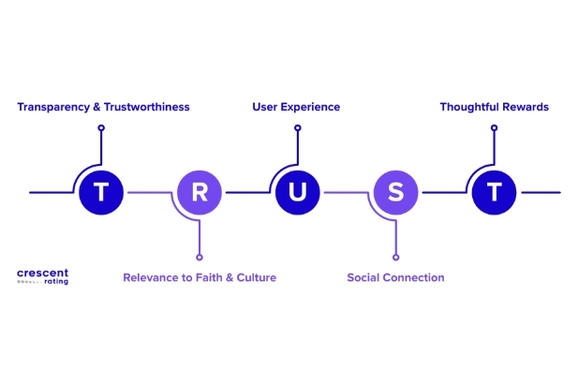
The TRUST Framework is a practical lens for understanding how Muslim consumers actually decide whom to trust, follow, and stay loyal to
T – Transparency & Trustworthiness: Openness in ingredients, pricing, governance, and ethics.
R – Relevance to Faith & Culture: Products and messages designed for real Muslim lives, not just permitted for them.
U – User Experience (The Value Proposition): Quality, reliability, and value that match or exceed mainstream offerings.
S – Social (Media) Connection: Discovery, evaluation, and advocacy built through digital communities.
T – Thoughtful Rewards (Loyalty Programs): Incentives that respect how Muslims think about money, ethics, and giving.
Let’s break down each pillar with data from Indonesia and Malaysia, and some uncomfortable truths.
Global stance matters. A brand’s position on “global ethical issues” (genocide, workers’ rights, environmental impact, humanitarian crises, etc.) significantly influences choice, scoring 4.3/5.0 in Malaysia and 4.0/5.0 in Indonesia. Consumers increasingly see their spending as a vote for their values.
Financial clarity is non-negotiable. In Islamic finance and general commerce, transparency around fees aligns with the Islamic principle of avoiding excessive uncertainty, hidden conditions, or misleading terms. The availability of faith-aligned financial services is a key selection driver, scoring 4.4/5.0 in Malaysia.
The “Halal” transparency gap. In focus groups, participants explicitly said they would “immediately switch” if a brand was not transparent about its Halal status. In Indonesia, where price sensitivity is high, consumers expect brands to explain why a product costs more (for example, ethical sourcing or higher-quality ingredients) to justify any premium.
|
Metric |
Malaysia Score |
Indonesia Score |
|
Global Ethical Stance (Impact on choice) |
4.3 / 5.0 |
4.0 / 5.0 |
|
Faith-Aligned Finance (Selection driver) |
4.4 / 5.0 |
High Price Sensitivity (Focus on value justification) |
Many “Halal” products still behave like black boxes, vague on sourcing, silent on governance, and hiding behind a logo. On paper, they may tick the compliance box. In practice, they erode trust.
If your Halal product requires a magnifying glass and a fatwa to understand the ingredients or fees, you are not operating in a trust economy. You’re gambling that consumers won’t look too closely.
They will.
At a minimum, brands serious about this market should:
• Implement QR codes that link to simple supply chain maps: country of origin, key suppliers, certifying bodies.
• Clearly explain who oversees Halal compliance (boards, advisors, certification bodies) and what they actually do.
• Provide plain-language fee breakdowns for financial products, no buried charges, no hidden conditions.
This level of transparency builds the trust that Muslim consumers instinctively seek, even if they cannot quote the legal details.
“Relevance” means moving from merely permitting Muslim consumption to designing for Muslim lifestyles.
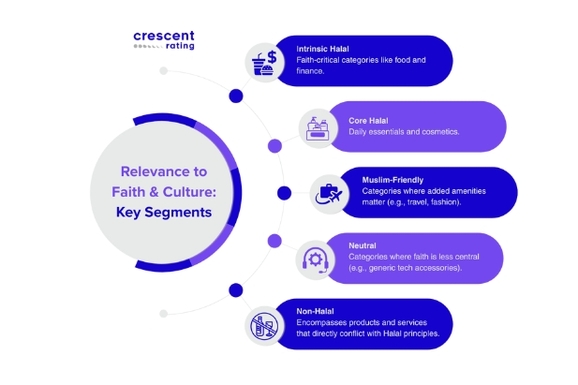
In our work and reports, we identify four key segments:
• Intrinsic Halal – faith-critical categories like food and finance.
• Core Halal – daily essentials and cosmetics.
• Muslim-Friendly – categories where added amenities matter (e.g., travel, fashion).
• Neutral – categories where faith is less central (e.g., generic tech accessories).
• Non-Halal - encompasses products and services that directly conflict with Halal principles.
Each requires a different level of religious and cultural relevance.
In Indonesia, “Halal Certification or Muslim-Friendliness” is a critical driver for brand selection, scoring 4.5/5.0.
In Malaysia, it scores even higher at 4.8/5.0, often ranking as the single most important factor for consumers.
Authentically representing Muslim identity in marketing, including Ramadan, modesty norms, and everyday Muslim life, scores 4.4/5.0 in Malaysia, signalling that consumers want to be seen, not just sold to.
Too many campaigns “include” Muslims without actually speaking their language, their rituals, or their realities. A generic Ramadan post dropped into a global content calendar is not relevance; it is tokenism.
You cannot photoshop a hijab onto a model, add “Ramadan Kareem” in your key visual, and call it a Muslim-consumer market strategy.
Treat your portfolio strategically:
1. Map your products into Intrinsic, Core, Muslim-Friendly, and Neutral segments.
2. For each segment, define the minimum faith and culture requirement:
• Intrinsic/Core: strict, visible certification and clear Halal assurance.
• Muslim-Friendly: amenities such as prayer spaces, Qibla directions, Halal food options, and modest fashion ranges.
• Neutral: less sensitive but still room for modesty and cultural respect.
3. Fix gaps in Intrinsic and Core first. These are unforgiving categories. If you get food or finance wrong, you won’t get a second chance.
Relevance here is not about “adding Arabic calligraphy”. It is about showing that your brand understands the lived rhythms of Muslim life, from prayer times and fasting patterns to modesty, family decisions, and community obligations.
A Halal logo does not excuse a poor user experience. Muslim consumers will not tolerate second-tier quality in the name of religious compliance.
Consistency of quality is the #1 driver of brand loyalty in Malaysia (score: 4.5/5.0) and the top selection driver in Indonesia (score: 4.6/5.0). When we ask why consumers switch brands, two reasons dominate:
1. Better quality elsewhere — the primary reason in both markets.
2. Price sensitivity — a close second, especially in Indonesia, where value-for-money is critical.
If the product fails on quality or value, the consumer leaves, even if it is Halal.
We see this repeatedly: the “Halal-assured” or “Muslim-friendly” version is slower, clunkier, and more expensive than the mainstream product.
That is not inclusion. That is a penalty for wanting to live by your values.
When your Islamic app is harder to navigate than your conventional app, or your Halal menu has fewer, poorer options than your standard menu, you are sending a message: “You are not our priority. You are a compliance requirement.”
Muslim-friendly offerings must meet, or exceed, the standard of your main products:
In finance, Halal-compliant funds should be as easy to find, compare, and invest in as conventional products, with competitive fees and a modern UX.
In food & beverage, Halal options should be as diverse, fresh, and premium as the rest of the menu, not a tired corner with limited picks.
In travel, Muslim-friendly services (prayer spaces, meal requests, modest swimwear options, etc.) should be integrated into the mainstream journey, not hidden behind special requests or awkward processes.
Over the next few years, Muslim consumers will increasingly avoid brands that require them to trade off between faith and quality. They are no longer willing to choose.
The path to purchase is now digital and social. The traditional TV ad is fading; the community review is thriving.
• In Indonesia, around 40% of consumers discover new brands via social media.
• In Malaysia, 26.2% discover via social media, with word of mouth — including family WhatsApp groups and peer recommendations — playing a significant role.
• TikTok and Instagram are the engagement leaders:
- In Indonesia, TikTok is a primary channel for brand interaction, driven by visually engaging, creator-led content.
- In Malaysia, TikTok and Instagram dominate youth attention, while Facebook remains relevant for community discussions.
Younger Muslims, especially Gen Z and younger Millennials, are treating TikTok as a search engine for reviews, how-tos, and “real experience” content.
If your media budget is still dominated by TV, while your target audience is discovering and judging you on TikTok and Instagram through third-party creators, you are not in control of your brand narrative.
The conversation about you has already moved. Your strategy hasn’t.
You need more than a content calendar; you need a social proof strategy:
• Work with creators who genuinely live the lifestyle — people whose modest fashion, travel planning, or financial decisions actually reflect Muslim values.
• Invest in “edutainment” content: short, visually engaging videos that:
- Show what makes your product Halal or Muslim-friendly (“Behind the Label” or “How We Source” series).
- Follow “A Day in the Life” of a Muslim consumer using your product in real contexts (work, prayer, travel, family).
- Walk through Ramadan, hajj, or everyday budgeting in a way that integrates your product without feeling forced.
• Encourage reviews and UGC from real customers, especially around trust moments: Halal assurance, service experience, complaint resolution.
If Muslims are scouting TikTok to see whether people “like them” actually use and trust your brand, you need to be present in that conversation — with integrity.
Loyalty programs are one of the most significant untapped opportunities in the Muslim market, particularly in Indonesia.
• In Malaysia, 66% of Muslim consumers are active loyalty members.
• In Indonesia, only 34% are enrolled.
This gap signals a huge opportunity — and a current failure to connect.
Data shows that traditional, points-heavy programs are losing favour:
• Instant gratification wins. “Discounts and coupons” are the #1 preferred reward, favoured by nearly 90% of consumers in both markets.
• Charitable integration matters. Sadaqah (voluntary charity) as a reward option appeals strongly to segments who prioritise social responsibility, allowing points to be converted into community benefit. Demand spikes during Ramadan and in response to humanitarian crises.
Most loyalty programs in this space are lazy. They reward spending, not values; they hoard data but don’t build trust; they treat Ramadan as a sales spike, not a season of generosity.
If your idea of “Ramadan engagement” is just double points on sugary drinks and late-night food, you’ve missed the spiritual context completely.
To design truly thoughtful rewards:
• Shift from “spend-to-get later” to “act-and-feel now”:
- Make discounts and coupons easy, instant, and meaningful for everyday purchases.
• Build charity and social impact into the core:
- Allow customers to convert points into meals, education support, or relief contributions with credible local partners.
- During Ramadan, introduce matched giving — for example, the brand matches all point donations 1:1.
• Recognise behaviours beyond spending:
- Reward participation in community events, educational content consumption, or sustainable choices, not just transaction volume.
When loyalty programs reflect Islamic values of generosity, community, and stewardship, rather than just consumption, they become more than a marketing tool. They become part of the consumer’s ethical lifestyle.
Winning the Muslim consumer is no longer about getting a certificate stamped and a logo printed. That is the baseline.
Compliance might keep you out of trouble. It will not earn you loyalty.
Over the next five years, I believe the market will split into two types of brands:
Box-tickers – those that treat Muslim consumers as a “segment” to be captured with seasonal campaigns and minimal adjustments.
Trust-builders – those that treat Muslim consumers as long-term partners whose trust must be earned daily.
The first group will chase labels, ad impressions, and short-term spikes.
The second will build TRUST — real Transparency, lived Relevance, uncompromising User Experience, meaningful Social connection, and genuinely Thoughtful rewards.
Today’s Muslim consumers are young, digital, value-driven, and deeply anchored in faith. They are not waiting for brands to catch up.
We know which side of this line they will choose.
The real question is: which side will your brand stand on?