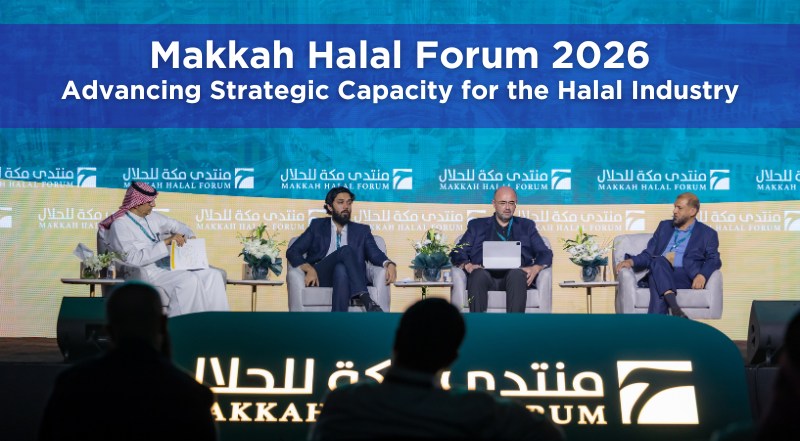
The Halal industry is undergoing a profound transformation. At the recent Makkah Halal Forum, held on February 16th, the conversation shifted from basic compliance to a more sophisticated theme: Professionalism and Strategic Capacity.
CrescentRating’s CEO, Fazal Bahardeen, was invited to join a high-level panel on “C-Suite Readiness for Strategic Capacity Building.” During the session, he laid out a roadmap for the future, centered on a singular, powerful idea: How quality-driven leadership culture elevates performance.
The Makkah Halal Forum 2026, held under the patronage of the Saudi Minister of Commerce, serves as a premier global platform for shaping the future of the Halal economy. With the tagline of “Where Leaders Shape the Halal Future”, the forum aims to establish Makkah as a global hub for Halal excellence by bringing together regulators, investors, and industry innovators.
Across three days, the 2026 program focused on transitioning the sector from niche markets to leading global industries. Key highlights of the program included:
Global Branding: Sessions explored drawing roadmaps for global Halal branding across various sectors.
Islamic Finance: Panel discussions held to discuss how the Halal industry and Islamic finance are vital to the national economic asset and the global economy.
Strategic Capacity: High-level discussions focused on C-Suite readiness and on building the institutional framework necessary for a professionalized industry.
Partnerships & Innovation: The forum witnessed the discussion of various topics including AI in the Halal industry, the role of influencers and Muslim women, and entrepreneurship.
For a C-Suite leader, "readiness" is beyond having the right certifications; it also includes the holistic culture that permeates every level of the organization. There are four key dimensions:
Cultivating a Mindset of Excellence (Ihsan): Taken from an Islamic concept, this dimension encourages every employee to have the spiritual and professional commitment to strive for the highest possible quality in every interaction.
Data-Led Quality: Leadership cannot operate in a vacuum. Using robust analytics—such as those found in the Global Muslim Travel Index (GMTI) Reports—allows leaders to replace guesswork with strategic precision.
Tech-Enabled Assurance: Traditional methods are being augmented by AI. In this sector, the human commitment to excellence can be guaranteed and amplified by AI as the automatic quality guarantor.
Dynamic Evolution: The Halal landscape changes rapidly. A quality-driven culture must be agile, allowing organizations to pivot as consumer behaviors and global regulations shift.
One of the most resonant points of the session was the concept of the Growth Triangle. Institutional capacity building is an "inside-out" process, and this is reflected in the model where Self, Community, and Company are mutually reinforcing.
Before an organization can scale its impact or influence the global industry, the journey must start from the Self. This involves personal mastery and leadership alignment. When a leader embodies the values of quality and integrity, that excellence naturally scales to the team (Community), inspiring a group of people who work with purpose. Eventually, the fostered culture of quality and integrity will be reflected in the entire organizational output (Company).
How do we know if our leadership culture is actually working? The answer lies in Measurable Quality. In a professionalized Halal industry, "quality" can no longer be a subjective feeling or a static certificate on a wall. CrescentRating has invested years in building frameworks where quality itself can be measured, from the ACES Framework (Access, Communications, Environment, Services) to the CHDA (CrescentRating Halal Dining Assurance).
Leaders must implement clear KPIs that track performance across the value chain. By quantifying excellence, whether through customer satisfaction scores, compliance accuracy, or service speed, organizations can identify gaps in their strategic capacity and address them with surgical precision.
To achieve this level of measurable quality, the industry must embrace the next frontier: AI-Enabled Intelligence. Technological leaps such as monitoring the global trends and consumer sentiment in real-time allows leaders to move from "reactive" management to "proactive" strategy. AI acts as an intelligence layer that will multiply and guarantee the team’s commitment to quality.
The final clear directive for the C-Suite is to stay curious. The new generation of Muslim consumers is tech-savvy, travel-hungry, and value-conscious. To build a better Halal industry, leaders must continuously monitor these evolving trends to ensure their strategic capacity matches the speed of the market. To do that, leaders can invest in social listening tools that would allow the team to be aware of the shifts in Muslim travelers’ preferences and thoughts, and develop strategic agility to adapt the company’s processes amidst the changing industry.
The Makkah Halal Forum served as a powerful reminder to every leader in the Halal industry that achieving the vision for global Halal excellence requires visionary leadership, more than just infrastructure.
As Fazal concluded in his session, the ultimate goal of strategic capacity building is to create an industry that is resilient, professional, and built on a foundation of absolute trust. By monitoring the latest trends and embracing the "Growth Triangle," C-suite leaders can ensure their organizations don't just participate in the Halal economy but lead it.
The path forward for a better Halal industry is clear: it begins with a commitment to quality that is as deep as the values it represents.