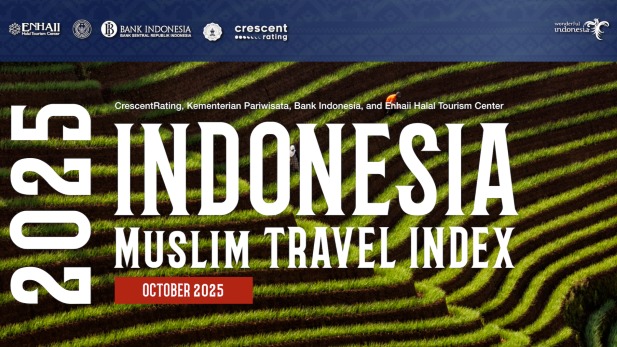
Halal tourism is rapidly becoming a key focus as the global travel industry adapts to evolving traveler preferences. With one of the world’s largest Muslim populations, Indonesia is positioning itself as a leader in global Muslim-friendly tourism. This commitment was highlighted through the launch of the Indonesia Muslim Travel Index (IMTI) 2025 at the 7th International Halal Tourism Summit, held during the Indonesian Syariah Economic Forum (ISEF) 2025.
Developed in collaboration between CrescentRating, the Ministry of Tourism, Bank Indonesia (BI), and the ENHAII Halal Tourism Center (EHTC), IMTI 2025 reflects a shared vision to strengthen Indonesia’s readiness and competitiveness in the growing Muslim travel market. This year’s edition introduces a tailored national framework that provides clearer guidance and measurable benchmarks to support sustainable growth across the country’s Muslim-friendly tourism ecosystem.
This year’s edition introduces a localized framework designed to enhance and measure Indonesia’s preparedness for the growing Muslim travel market. Using this method, 15 Indonesian provinces are assessed and ranked according to their strengths and potentials.
At its foundation, the IMTI applies the CrescentRating ACES Model (Domestic), originally developed for the Mastercard-CrescentRating Global Muslim Travel Index (GMTI) to judge provinces across four key dimensions:
Access (10%) – Measures connectivity both to and within each province.
Communication (20%) – Evaluates promotion, outreach, and stakeholder engagement.
Environment (30%) – Examines policy support, governance, and destination readiness.
Services (40%) – Reviews the range and quality of facilities available to Muslim travelers.
Together, these dimensions provide a comprehensive provincial benchmark, enabling policymakers and industry stakeholders to identify opportunities, address gaps, and accelerate the next phase of Muslim-friendly tourism development across Indonesia.
In Muslim-friendly tourism, Access extends beyond physical gateways. It represents how effortlessly and confidently Muslim travelers can explore a destination from arrival to departure. The Access criterion measures how well a province supports mobility and connectivity, which are the key factors influencing destination preference, trip planning, and overall visitor satisfaction. The indicators assessed include:
Air Connectivity
Rail & Sea Links
Road Infrastructure
Public Transport & E-Hailing Services
Together, these metrics reflect the degree to which travelers can move seamlessly within and between provinces, shaping the ease and inclusivity of the overall travel experience.
Communication is central to how destinations effectively present, promote, and personalize their tourism experiences for Muslim travelers, both domestically and globally. This dimension assesses how well a province educates its stakeholders, engages the Muslim travel market, and provides clear, reliable, and culturally relevant information to visitors.
Below are the evaluated indicators:
Muslim Visitor Guide
Stakeholder Education
Market Outreach
Tour Guide Readiness
These indicators reflect how effectively a destination communicates its unique value, adapts to evolving traveler expectations, and builds meaningful engagement with diverse audiences.
The Environment criterion captures the broader tourism landscape where policy, sustainability, and destination readiness converge to define the quality of traveler experiences.
A strong tourism environment ensures that visitors enjoy safety, comfort, and a sense of harmony with the local community and natural surroundings. This dimension assesses how effectively provinces integrate tourism growth with sustainability principles, environmental stewardship, and the overall well-being of visitors.
The Environment dimension includes the following indicators:
Domestic Tourist Arrivals
International Tourist Arrivals
Muslim-friendly Tourism Policy
Regional Tourism Organization
Accessible Tourism
Sustainable Tourism
Basic Utilities Availability
Collectively, these measures reflect how destinations balance development with responsibility — protecting local environments while fostering spaces of trust, inclusivity, and peace of mind for Muslim travelers.
The fourth pillar of the ACES Framework, Services represents how effectively destinations meet the practical and spiritual needs of Muslim travelers. This dimension measures the consistency and quality of facilities and services offered across provinces — from certified Halal dining and accessible prayer spaces to clear, reliable visitor information.
In Muslim-friendly tourism, strong service delivery ensures that travelers can explore with comfort and confidence, knowing that their faith-based requirements are thoughtfully accommodated throughout their journey. Beyond essential amenities, quality tourism services also enhance the destination experience through diverse attractions and cultural sites.
This dimension evaluates the following indicators:
Certified Halal Restaurants
Airport Facilities
Hotel Facilities
Tourist Attractions
Cultural Heritage Sites
Tourist Information Centers
In combination, these indicators demonstrate how well destinations support holistic, inclusive travel experiences — where convenience, cultural authenticity, and spiritual assurance come together to define true Muslim-friendly hospitality.
Through in-depth research and analysis, each province demonstrates varying strengths across the four dimensions. The detailed results are presented below.
In IMTI 2025, Java’s strong performance underscores the importance of robust connectivity in advancing Muslim-friendly tourism. With its well-developed infrastructure, integrated transport systems, and high urban mobility, provinces such as DKI Jakarta, Jawa Timur, and Banten consistently lead in Access with scores from 68.0 to 86.9, making travel smoother, faster, and more reliable.
The data also highlights key disparities; even among top-performing provinces, strengths are not evenly distributed across all dimensions. For instance, Jawa Barat, though located in the neighbouring province, places only 10th in Access with a score of 40.5, while Sumatera Barat faces similar constraints despite its strong tourism appeal. These findings signal the need for targeted investments in infrastructure and interconnectivity to maintain balanced and sustainable growth.
Notable positive examples include DI Yogyakarta with a score of 62.6, demonstrating the impact of effective public transport systems and coordinated urban planning in improving Access scores. Conversely, Riau with a score of 40.0 illustrates how limited intercity transport options beyond capital hubs can restrict visitor movement. Enhancing intra-provincial mobility, airport capacity, and inter-regional transport links will be essential to ensure seamless travel for both domestic and international visitors.
Beyond Java, several provinces continue to face challenges in infrastructure readiness and limited air connectivity. While Sumatera Barat and Nusa Tenggara Barat (NTB) perform well due to proactive provincial strategies, underperforming regions such as Kalimantan Selatan, Gorontalo, and Bengkulu reveal the urgent need to decentralize tourism growth and establish stronger mobility corridors that connect emerging destinations across the archipelago.
The results reveal that Sumatera Barat leads the Communication dimension with a score of 77.8, demonstrating excellence in stakeholder education and market outreach. Its achievement reflects years of consistent engagement and a policy-driven approach toward strengthening Halal tourism. Following closely, Nusa Tenggara Barat (NTB) secured a score of 68.9, illustrating how effective communication can overcome geographical barriers. Through strong public-private collaboration and well-developed Muslim visitor guides, NTB has successfully positioned itself as a global reference point for Muslim-friendly tourism.
In third place, Jawa Barat highlights how regional communication strategies — particularly the availability of trained tour guides — can enhance destination visibility and traveler engagement at the local level.
At the other end of the spectrum, provinces such as Gorontalo, Kepulauan Riau, Kalimantan Selatan, Riau, and Bengkulu trail behind, each scoring below 30 in the Communication dimension.
This wide gap emphasizes the need for targeted initiatives, including the training and certification of Muslim-friendly tour guides, the development of standardized visitor information materials, the expansion of digital outreach, and greater interregional collaboration to amplify shared narratives. For emerging destinations, effective communication is the foundation of growth. It builds awareness, nurtures partnerships, and connects local potential with both national and international opportunities.
Jawa Barat leads the Environment category with a score of 82.8, showcasing strong governance, cohesive tourism policy frameworks, and a firm commitment to sustainable and accessible development. The province’s integration of environmental protection within its tourism planning provides a model for long-term, responsible growth that balances economic potential with ecological stewardship.
Following closely, Nusa Tenggara Barat (NTB) ranks second with a score of 82.5, reinforcing its position as a global benchmark for eco-conscious and inclusive tourism. Building on international recognition for its sustainable hospitality and green tourism initiatives, NTB demonstrates that responsible tourism can drive both economic resilience and environmental integrity.
Sumatera Barat (75.7), Aceh (72.3), and Banten (71.8) complete the top five, reflecting a strong alignment between cultural heritage preservation and sustainable tourism management. Their progress underscores how shared strategic vision, stakeholder collaboration, and cultural continuity contribute to environmental readiness.
Meanwhile, provinces such as Jawa Tengah and Sulawesi Selatan continue to advance through investments in public utilities, transportation networks, and community-led initiatives — illustrating how modernization can successfully coexist with heritage preservation and local empowerment.
Jawa Tengah leads the Services category with a score of 74.6, demonstrating strong integration of faith-based amenities within its broader tourism development framework. The province’s extensive Halal dining options, accessible prayer facilities, and traveler-friendly infrastructure reflect a well-balanced approach that bridges cultural heritage preservation with modern hospitality excellence.
Aceh, ranking second with a score of 68.8, continues to lead by example through its Sharia-based tourism model, embedding religious considerations across all service touchpoints — from airport terminals to community-managed attractions.
Meanwhile, Jawa Barat (68.0) highlights how effective provincial coordination and comprehensive hospitality training can elevate overall visitor satisfaction. Other strong performers such as DKI Jakarta (66.3) and Jawa Timur (63.6) benefit from advanced infrastructure and global connectivity, though variations in service consistency between urban centers and secondary attractions remain evident.
These findings underscore the importance of focusing not only on infrastructure and scale, but also on uniform quality, accessibility, and cultural sensitivity across all stages of the traveler journey — ensuring that every experience reflects the principles of Muslim-friendly hospitality.
The 2025 results highlight notable shifts within Indonesia’s Halal tourism landscape. Several provinces have demonstrated measurable progress, driven by renewed investments and stronger policy commitments. Scores across the top ten have improved, reflecting positive momentum nationwide. The index demonstrates that continued focus remains essential to ensure inclusive, resilient, and sustainable growth.

Ranked #1 nationwide, Jawa Barat leads through an outstanding Environment score, underpinned by strong government commitment and robust tourism policies. High volumes of both domestic and international arrivals reinforce its reputation as a visitor-ready and responsible destination. Its well-developed infrastructure supports this success, though further improvements in Access, particularly inter-provincial connectivity, presents a clear opportunity to elevate its standing even further.
In second place, Sumatera Barat demonstrates excellence through perfect scores in the Communication and Environment pillars, particularly in Stakeholder Outreach, Market Education, and Commitment to Halal Tourism. This strategic foundation translates into consistent visitor experiences and strong service delivery across accommodation, dining, and attractions. Continued efforts to enhance accessibility and heritage promotion will help unlock additional tourism potential.
Globally recognized for its commitment to Muslim-friendly tourism, Nusa Tenggara Barat (NTB) ranks third, excelling in the Environment and Communication dimensions. High international arrivals, organized governance structures, and a robust Halal culinary ecosystem define its success. Opportunities remain to strengthen internal transport connectivity and highlight underrepresented cultural assets, ensuring travelers experience the province’s full diversity.
The rankings have shown incredible growth, yet a saddening wide gap between provinces in Indonesia. To elevate Indonesia’s preparedness for the growing Halal tourism, a few steps need to be taken.
For every aspect in the ACES framework, Indonesia needs to step up their partnership and cooperation. With every government body and external parties working seamlessly, this will result in great things, including better accessibility for Muslim tourists, consistent policies, and improvements in service performance.
While communication performance continues to improve across provinces, consistency remains a defining challenge. Travelers are most responsive to destinations that communicate with clarity, confidence, and authenticity.
For Indonesia, the next phase lies in ensuring that every province aligns its messaging, presenting Muslim-friendly tourism not as a niche initiative, but as an integral pillar of the national tourism identity. A unified communication strategy will strengthen Indonesia’s brand coherence, enhance visitor trust, and reinforce the country’s global positioning as a leading Muslim-friendly destination.
The wide disparity between provinces highlights the urgent need to decentralize resources and development efforts. While the top three provinces have shown the positive impact of aligning policy, culture, and service excellence, Indonesia must continue to extend this progress beyond Java, empowering emerging regions to take part in the country’s tourism growth.
A more balanced approach — where all provinces have the opportunity to build capacity, attract investment, and strengthen their Muslim-friendly tourism ecosystems — will ensure that Indonesia’s success story is shared nationwide.
Indonesia’s domestic progress occurs alongside rising global competition. Having achieved the #1 global ranking in the Global Muslim Travel Index (GMTI) in 2019, 2023, and 2024, Indonesia now stands at 5th place in GMTI 2025, maintaining a strong score of 76.
This shift underscores the importance of continuous innovation and strategic collaboration. Key priorities moving forward include:
Enhancing connectivity within and between provinces.
Strengthening Halal assurance across tourism services and products.
Encouraging local innovation to diversify tourism offerings.
Expanding inclusivity and accessibility for all Muslim travelers.
With its rich cultural heritage, natural beauty, and strong institutional support, Indonesia remains well-positioned to regain its top global standing. Achieving this will require unified efforts from both national and provincial stakeholders to transform insights from IMTI 2025 into impactful, on-the-ground progress.
For the full IMTI 2025 report, please check here.
#IMTI2025 #TravelReports #CrescentRating #IndonesiaTravel #ISEF2025