This year, CrescentRating conducted a survey to understand the spiritual commitment of Muslims during the month of Ramadan, comparing numbers from 2022, 2024, and 2025. The primary objective of this survey was to capture the top spiritual activities that Muslims anticipate during the holy month. The selected activities for the survey included a range of religious practices, from the consistency in performing the Five Daily Salah to the distribution of Zakat and the completion of the Quran recitation. Respondents were asked to rank the top three spiritual activities they looked forward to during Ramadan, providing information on the Muslim community's religious priorities and personal commitments.

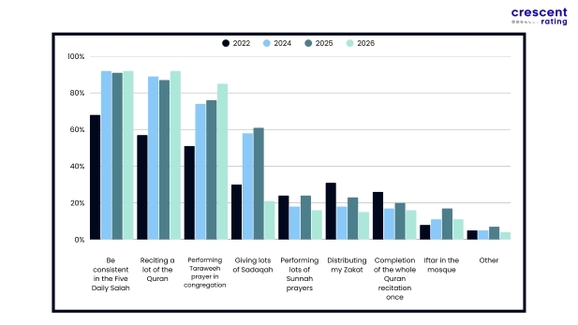
1. Constant Commitment to Daily Salah: Prioritizing the five daily prayers remains high, with a narrow increase from 91% to 92% compared to the 2025 data. The displayed data consolidates the fact that the five daily prayers are considered essential by most Muslims, as they are the second pillar of Islam.
2. Growing Engagement with the Quran: The survey data saw an increase of 5% in Muslims looking forward to reciting the Quran during the holy month of Ramadan in 2026, reaching 92%. This highlights the growing importance of the Quran as an essential part of the holy month of Ramadan.
3. Increased Participation in Taraweeh Congregations: The Taraweeh congregation is exclusive to the holy month of Ramadan. The willingness to participate in the Taraweeh congregations for this year saw an increase of 9%, jumping from 76% to 85% within a span of one year. Taraweeh in Ramadan is not only considered an act of faith, but it also serves as a catalyst in bonding with other fellow Muslims, known as Ummah bonding.
4. Shifts in Emphasis on Giving Sadaqah and Zakat Distribution: According to the survey results, emphasis on giving Sadaqah in 2026 plummeted to 21% from 61%, marking a sharp decline within a year, while Zakat distribution declined from 23% in 2025 to 16% in 2026. This shift may point to changes in the financial capacity among Muslims this year.
5. Changes in Interest in Sunnah Prayers and Efforts to Complete Quran Recitation: Data collected from the survey indicated a similar trend observed in 2022-2024 occurred among Muslims aiming to complete the Quran at least once during the holy month of Ramadan in 2026, showing a decrease from 20% in 2025 to 16%. Interest in Sunnah prayers also dropped from 24% in 2025 to 16%. The decrease in participation in both activities may indicate a busier schedule among Muslims due to various factors.
6. Shifts in Attendance at Mosque Iftars: Aside from the Taraweeh congregations, attending Iftar at Mosques also serves as a social bonding activity among Muslims. The survey indicated that there is a decrease among Muslims in choosing mosques as the place to break their fast at 11% in 2026, compared to 17% in 2025. This shift may be due to changes in spiritual and diet preferences.
The five daily prayers and Quran recitation are the core spiritual acts of a Muslim. During the holy month of Ramadan, Quran recitation is highly emphasized, benefiting the spiritual atmosphere of Ramadan. Despite increasingly demanding work schedules, these practices remain consistent, suggesting a sustained prioritization of spiritual obligations, which may also reflect the growing intentional and value-driven lifestyle. At the same time, the growing accessibility of digital resources online, such as Quran applications and prayer time reminders, has made it easier to integrate worship into daily routines, supporting consistent spiritual practices.
For many Muslims, the holy month of Ramadan encompasses both spiritual observance and community engagement. Participation in congregational activities, such as Taraweeh prayers and Iftar together at mosques, highlights how shared experiences during Ramadan strengthen bonds with family, friends, and the wider community. The arrival of Ramadan also brings various festive activities, with Ramadan-themed bazaars being a common event in Southeast Asia.
The slight decrease in mosque Iftar participation likely reflects a change of preferences, especially among younger individuals who may seek quieter settings over crowded places. Rising health awareness, especially among younger Muslims, may also be another factor, prompting them to choose healthier Iftar meals at home or dining elsewhere. Despite this, the majority are still willing to participate in Taraweeh prayers, indicating a consistent sense of togetherness within the community while fostering spiritual growth.
Along with the obligatory Zakat, Muslims are encouraged to give Sadaqah or charity, which acts as a social responsibility to help those in need and foster solidarity within the community. Both Zakat and Sadaqah saw a decline despite the availability of digital payment. This shift may indicate changes in financial capacity among Muslims as income inequality does seem more apparent in recent years in developing countries, affecting the middle-class, coupled with the rising cost of living and unemployment rate, which causes financial instability for Muslims, excluding them from charity.
While Zakat Fitrah is strictly tied to the holy month of Ramadan, Zakat Maal can be paid anytime once the Nisab and Hawl are within reach, yet many Muslims prefer to pay Zakat Maal during the holy month of Ramadan. In addition, the persistent appreciation of gold has resulted in the elevation of Nisab, thus resulting in the reduction of eligible Zakat Maal contributors. Furthermore, various conflicts have erupted globally in some parts of the world, affecting the lives of many Muslims.
During the holy month of Ramadan, many Muslims spend their free time performing Sunnah prayers and completing the Quran as a form of commitment to spiritual growth. From an early age, Ramadan is often framed as a form of metamorphosis, a period of reflection and self-improvement. However, the lower prioritization of these preferred practices by younger Muslims, particularly Gen Z, may reflect changing time availability and modern commitments, as individuals balance spiritual connections with other responsibilities. Nevertheless, engagement in such activities remains present, indicating continuous commitment during Ramadan.
Muslims in the modern world now no longer see Ramadan and acts of devotion as something foreign to their modern lifestyle. Even with shifts in some activities, many Muslims, until this day, are able to incorporate their spiritual commitment into their lives and not as a hurdle amidst their busy schedule.
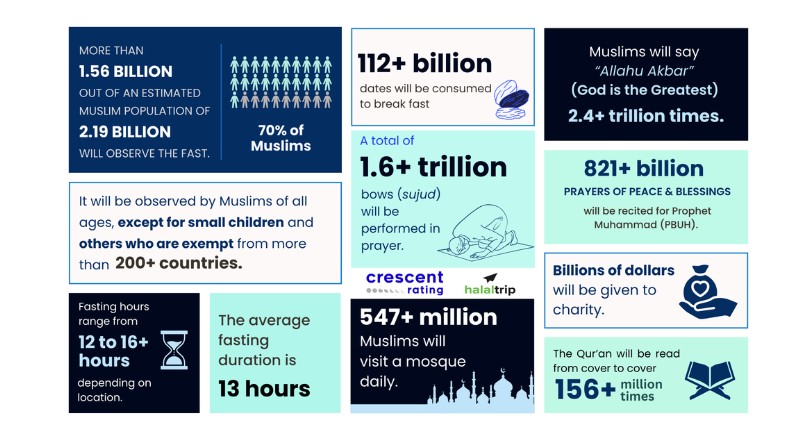
Compared to last year's Ramadan, fasting durations this year will witness an inverse trend where countries in the Northern Hemisphere, particularly in parts of Europe, have a shorter fasting duration compared to the countries within the Southern Hemisphere, notably Argentina. Meanwhile, countries located near the equator, such as Indonesia and Malaysia, will continue to observe a steady fasting duration of around 13 hours. Based on our findings, Muslims globally are expected to fast between 12-15 hours, depending on their geographic location, with an average duration of approximately 13 hours.
Since the launch of the first modern generative AI (GAI) platforms in 2022, technological advancements have undergone a paradigm shift as GAI itself brought significant changes to various industries. GAI at present serves as a facilitator for information acquisition through customizable inquiries in the form of prompts that enable the GAI model to give answers tailored to the specific instructions given by users. This method significantly reduces the time used for research, fostering more agile decision-making as compared to the conventional manual search processes.
In the upcoming Ramadan, AI's role as a digital assistant is expected to become more prominent, as Muslims may increasingly rely on AI tools for various needs, including Zakat calculations, personalized reminders to track Quran recitation progress, and monitoring Sunnah prayers.
The insights obtained from the survey indicated the strong commitment in the Muslim community towards spiritual growth during the holy month of Ramadan. Current trends saw a shift in focus, where the core of fundamental practices, such as the five daily prayers and Quran recitation, with the addition of Taraweeh congregations, have recorded steady or increased engagement, while other practices, such as interest in Sadaqah, Zakat distribution, mosque Iftar participation, and Sunnah prayers, saw a gradual decrease in prioritization.
Changes in fasting duration across regions and the growing use of digital tools also reflect the evolving context in which Ramadan is observed. Nevertheless, the emphasis on spiritual growth in the holy month of Ramadan remains stable as Muslims continue to integrate religious spiritual commitment into their modern lifestyle.