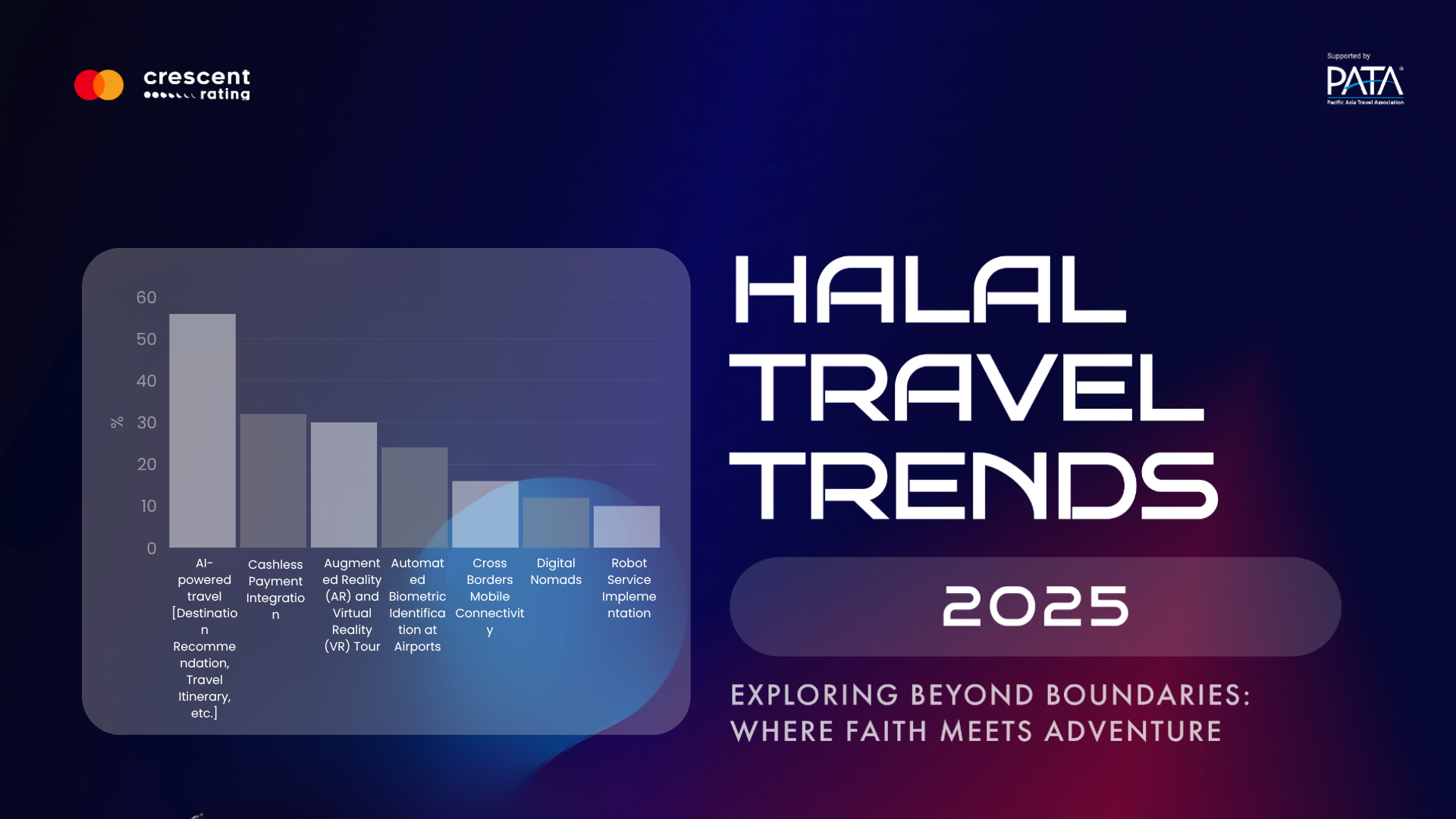
Immersion in today’s world extends into the digital realm. As travel becomes more connected, seamless, and personalised, Muslim travelers are embracing a wave of smart solutions that enhance rather than replace human engagement. The Halal Travel Trends 2025 report, while detailing digital innovation in its own category, also reveals how tech elevates immersion — by removing friction, enabling discovery, and supporting religious values along the journey.
Below, we explore four technological touchpoints that are reshaping the immersive experience of travel for Muslim consumers: the rise of AI agents, the shift to cashless ecosystems, borderless immigration, and intelligent infrastructure.
The Rise of AI Agents: From Booking to Blessings
“Digital and technological innovations will continue revolutionizing the tourism industry, offering enhanced experiences and streamlined operations. Artificial intelligence (AI) and predictive analytics will play a pivotal role in reshaping how travelers plan their journeys.”
Dr. Mohamed Battour, Professor, Supreme Council of Universities, Egypt
Artificial intelligence is no longer confined to chatbots. Today’s AI agents serve as always-on travel companions — assisting with itinerary planning, Halal restaurant recommendations, language translation, and even reminders for prayer times and Qibla direction.
Muslim travelers are increasingly turning to AI-powered apps for deeply personal assistance. Whether it's curating a day in Istanbul that includes visits to historic mosques and Halal cafés, or finding female-only wellness centres in Kuala Lumpur, AI agents are helping travellers align their journeys with both personal preferences and faith requirements.
As these digital companions evolve, they are becoming cultural intermediaries — translating not just words but customs, etiquette, and sensitivities. By providing real-time, context-aware support, AI enables immersive travel without the anxiety of being lost, misunderstood, or unprepared.
The Cashless Shift: Seamless, Secure, and Shariah-Friendly
Gone are the days of fumbling with foreign currency. Cashless travel is now the norm in many destinations, allowing for smooth, secure, and transparent transactions that fit neatly into the values of Muslim travelers — particularly those seeking ethical finance and ease.
From digital wallets and QR-based payments to biometric verification at Halal eateries and attractions, the cashless ecosystem reduces language and exchange barriers. It also creates space for faith-based financial tools.
For Muslim travelers, the benefits go beyond convenience. Cashless systems offer greater transparency in transactions — a value aligned with Islamic principles — and help travelers better manage budgets, track spending, and support local businesses that reflect their values.
Effortless Immigration: A New Chapter in Stress-Free Travel
One of the most frustrating pain points in global travel is often the immigration process. Long queues, paperwork, and uncertainty can disrupt what should be a welcoming start. However, a quiet revolution is underway. Seamless immigration systems — powered by digital identity, pre-clearance, and biometric authentication — are transforming borders into bridges.
For Muslim travelers, the shift to digital clearance enhances efficiency while preserving a sense of dignity throughout the immigration process. With fewer invasive procedures, less confusion about documentation, and pre-arrival screenings that respect privacy and beliefs, these systems make the travel experience more welcoming.
Several destinations are already piloting frictionless immigration through apps that integrate visa information, vaccination records, and identity verification. Such systems reduce wait times and elevate first impressions — allowing travelers to focus not on logistics, but on experiencing the soul of a place from the moment they land.
Smart Travel Infrastructure: From Airports to Prayer Pods
Beyond mobile apps and payment technology, intelligent infrastructure is quietly transforming how Muslim travelers interact with physical space. Airports with smart signage in Arabic, prayer pods with automated Wudu facilities, and facial recognition systems that adapt to modesty requirements are not science fiction — they are emerging realities.
These innovations reflect a broader shift in hospitality: from accessibility to adaptability. It’s no longer enough for Halal-friendly infrastructure to exist; it must be easy to locate, culturally attuned, and digitally supported. Smart systems can direct travelers to quiet prayer areas, alert them to the nearest Halal food outlet, or notify them of changing prayer times in a new timezone.
The more intelligent the space, the more immersive the journey. Muslim travelers, especially digital-native Gen Zs, are increasingly expecting destinations to meet them where they are — not just physically, but technologically and spiritually.
Digital Immersion with a Human Touch
As technology becomes more integrated into every step of the journey, the most successful travel experiences will be those that enhance human connection rather than replace it. For Muslim travelers, immersive travel does not mean being overwhelmed by tech — it means using tech to remove barriers, foster discovery, and uphold faith-based values.
From AI companions that recommend Halal hideaways to seamless borders that welcome with respect, digitally immersive journeys offer a new kind of depth — one that begins with a screen but leads to real-world connection.
In the Halal travel space, digital immersion is not just about innovation — it’s about intention. And as 2025 approaches, that intention is clear: to travel with ease, authenticity, and faith in every click, tap, and step.
Prefer to listen? Get the audio summary of this article here.